HOST GUIDE
Creating a High-Converting Listing on Villario
Practical guidance on photos, descriptions, house rules, pricing, safety, and search visibility — so guests click through, feel confident, and book.
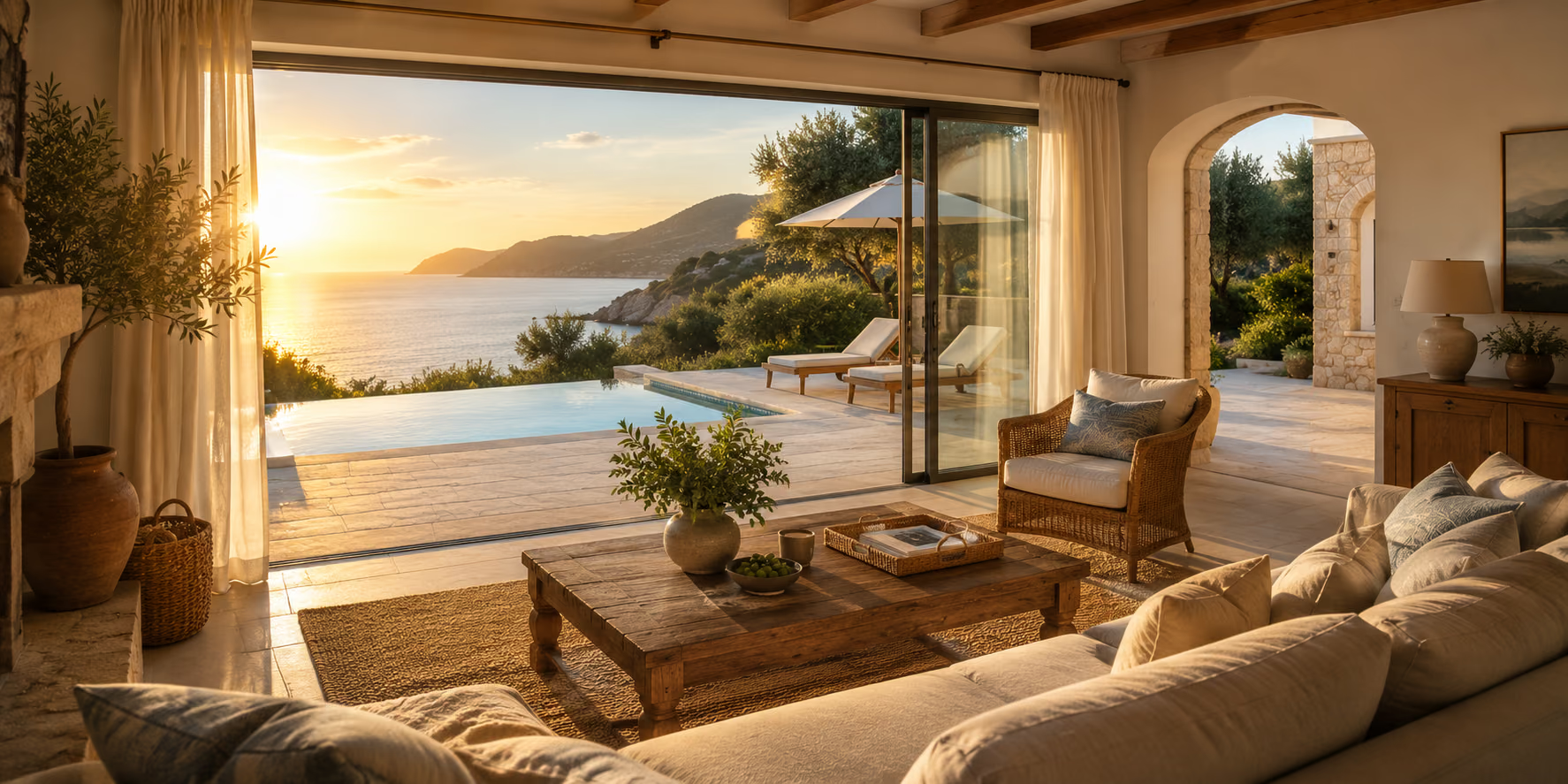
Creating a High-Converting Listing on Villario
A great listing does more than describe a property — it earns a booking. Guests decide within seconds whether to keep scrolling or click through, and every detail after that click either builds confidence or plants a reason to hesitate. This guide walks through what actually moves the needle: photos, description, house rules, pricing, safety and verification, and how your listing gets found in the first place.
Photo Best Practices
Photos are the single biggest factor in whether a guest clicks through at all. Before anything else on the page is read, your images have already made the first impression.
Lead with your strongest shot. Your cover photo carries more weight than any other image you’ll upload — it’s what appears in search results before anyone has even opened the listing. Choose the single frame that best captures what makes the property special: a striking view, an inviting outdoor space, or a beautifully styled living area. Avoid leading with a bathroom, a bedroom, or anything that could belong to almost any property.
Shoot in natural light. Open the curtains, turn off dim overhead lighting, and work during the day whenever possible. Natural light makes spaces feel larger, warmer, and truer to how a guest will actually experience them. If a room only looks good with the lights on, treat that as a cue to improve the space before your next shoot rather than something to fix in post-production.
Show every space a guest will use. Cover each bedroom, the bathroom(s), the kitchen, living or dining areas, and outdoor spaces such as a garden, balcony, or pool. Guests comparing several properties often choose the one where they can already picture their whole stay, not just the prettiest single room.
Declutter and stage before you shoot. Clear countertops, make the beds, tuck away cables and toiletries, and remove anything that looks more “lived in” than “guest ready.” A few thoughtful touches — fresh flowers, neatly folded towels, a set table — photograph far better than a room that is merely tidy.
Use wide, straight-on angles. Shoot from corners rather than the centre of a room to capture more of the space, and keep the camera level. A tilted horizon or converging walls reads as unpolished even when the rest of the image is strong. Most phones have a built-in level or grid that makes this easy to check before you press the shutter.
Keep editing honest. Brightening and straightening is good practice; changing the apparent size, layout, or condition of a space is not. A guest who arrives to find a room smaller or different from the photos is a guest who leaves a disappointed review, no matter how well the rest of the stay goes.
Update photos as the property changes. Renovated the kitchen? New outdoor furniture? Fresh paint? Refresh the images to match. Stale or inaccurate photos are one of the most common sources of guest disappointment — and that disappointment shows up in reviews, which affect every future booking.
Writing Accurate and Compelling Descriptions
Your description has two jobs at once: it sells the property and it sets expectations. The best listings do both without contradiction.
Open with what makes this property different. Skip the generic “Welcome to our lovely home.” Lead instead with the one or two things that genuinely set it apart — a sea view, a short walk to the old town, a private pool, a beautifully renovated interior. Guests skim, so your strongest selling point needs to be in the first sentence, not the third paragraph.
Be specific, not just enthusiastic. “Spacious and comfortable” describes almost nothing. “A king bed in the main suite, plus a sofa bed in the snug that sleeps two more” tells a guest exactly what they’re getting. Specifics build trust and help the right guests self-select, while vague superlatives simply blend into every other listing they’re comparing.
Describe the space guests will actually use. Walk through the property room by room, or area by area, the way a guest would experience it on arrival. Mention the practical details that influence a booking decision — how many people the sleeping arrangements comfortably fit, whether there’s air conditioning or heating, what’s included in the kitchen, and anything unusual about layout or access (a steep driveway, a shared entrance, stairs with no lift).
Sell the location, not just the property. Guests are booking a stay in a place, not only four walls. Mention what’s genuinely nearby and relevant — a beach, restaurants, transport links, notable sights — without turning the description into a tourist brochure disconnected from the property itself.
Never overstate or omit a material fact. If there’s road noise, a shared pool, no air conditioning, or a steep flight of stairs to the front door, say so. Guests forgive a limitation they knew about in advance; they don’t forgive one they discover on arrival. An accurate description that sets realistic expectations converts into five-star reviews far more reliably than an overselling one that wins the booking but disappoints on the day.
Write for skimmers. Use short paragraphs and let the text breathe. A guest deciding between several open tabs is skimming, not reading closely — dense, unbroken blocks are far more likely to be abandoned halfway through.
Setting Clear House Rules
House rules protect you and set expectations before guests ever arrive. The goal is clarity, not a wall of restrictions.
Cover the essentials directly. Be explicit about check-in and check-out times, whether smoking is permitted anywhere on the property, your policy on pets, whether parties or events are allowed, and any quiet hours. These are the questions guests ask most often; answering them upfront avoids both pre-booking message threads and post-arrival misunderstandings.
Explain the reasoning briefly where it helps. “No parties or events” reads as a flat restriction. “No parties or events — this is a quiet residential street and we want to be good neighbours” reads as reasonable. A short reason makes a rule easier to respect, not just follow.
Flag anything unusual about the property itself. A temperamental water heater that needs a minute to warm up, a gate that must be latched a particular way, a septic system that can’t handle certain items — include these details. They aren’t “rules” in the usual sense, but they prevent avoidable problems and awkward mid-stay messages.
Keep the tone welcoming. House rules are read by someone deciding whether to trust you with their holiday. A long list of prohibitions can undercut an otherwise warm listing. Aim for clear and reasonable, not exhaustive.
Set your cancellation policy deliberately. From a guest’s perspective it is effectively part of the house rules — it directly affects their booking decision, especially for those booking further ahead or with less certain plans. A flexible policy tends to convert more bookings; a stricter one better protects your calendar from late cancellations. There is no universally right choice. Pick the one that matches how you actually want to manage your calendar, and stay consistent.
Pricing Strategy Without Booking Fees
Villario doesn’t add a booking fee on top of your listed price. What a guest sees at checkout is your rate, plus any add-ons or taxes you’ve configured — nothing hidden by the platform. That is a real pricing advantage worth using deliberately, not merely a background fact.
Price to be genuinely competitive, not just cheaper. Because no platform fee inflates the final amount, your listed price sits closer to the guest’s true cost than it would on a platform that adds one. You can be priced identically to a competitor elsewhere and still come out cheaper at checkout — an advantage worth mentioning in your description or messaging rather than leaving guests to discover only through comparison shopping.
Use seasonal and demand-based pricing. Set higher rates for peak season and school holidays, and lower rates for shoulder and off-season periods so the calendar stays filled year-round. A property sitting empty at a high price earns nothing. A well-priced calendar with strong occupancy usually outperforms a high asking price with long gaps.
Consider a damage deposit instead of a higher nightly rate. A refundable deposit protects you against genuine incidents without inflating the headline nightly rate — the first figure most guests compare across listings. When the deposit is automatically refunded after checkout (barring an actual dispute), it reassures guests it isn’t a hidden charge.
Use add-ons for genuine extras, not core value. Early check-in, a welcome hamper, mid-stay cleaning — these are useful ways to offer extra value without folding the cost into every booking’s nightly rate. Keep them genuinely optional and clearly priced so a guest never feels an add-on is really a disguised mandatory fee.
Reflect your minimum stay in your pricing, not just your rules. If you require a minimum stay, make sure the nightly rate still looks reasonable when multiplied out. Guests evaluating a three-night minimum will do that multiplication themselves before booking, whether or not you have spelled out the total.
Highlighting Safety Features and Verification Status
Trust is one of the biggest factors in a guest’s decision to book a property they have never seen in person. Safety and verification information is some of the most persuasive — and most underused — content on a typical listing.
Mention your verification status directly. If the property has completed Villario’s verification process, or your registration is confirmed where local regulations require one, say so in the description. Guests increasingly look for this signal, and a listing that states it explicitly does work that a badge alone does not fully achieve.
List your genuine safety features. Smoke alarms, a carbon monoxide alarm near gas appliances, a fire extinguisher, a first-aid kit, secure locks on all external doors — these details reassure cautious guests and cost nothing to mention. If there is a pool, note any safety features around it (fence, cover, clearly visible depth marker). Pool safety is a real and common concern, especially for families.
Be upfront about security cameras, if you have any. Any exterior camera or similar device must be disclosed — this is not optional, and guests are entitled to know before they book. Framing it plainly (“An exterior camera covers the driveway and front door for security”) reads as responsible rather than intrusive, provided the cameras are genuinely exterior-only. Cameras are never permitted in private spaces such as bedrooms or bathrooms.
Reassure guests about payment security. Because Villario handles payment directly rather than requiring guests to send money to you personally, it is worth briefly noting that bookings and payments are protected through the platform. Some guests, particularly those newer to independent villa rentals, specifically look for this reassurance before booking with a host they do not already know.
Respond to safety-related questions promptly. A prospective guest who messages about security, the neighbourhood, or a specific safety feature is often close to booking. A fast, thorough answer frequently converts directly into a reservation; a slow or vague one sends them back to the search results.
Improving Your Listing’s Search Visibility
A compelling listing only converts guests who actually find it. A little attention to how the property appears in search results goes a long way, both on Villario itself and on external search engines.
Set a custom SEO title and description. Every property can have its own SEO title and description, written in each of the listing’s locales. This is what search engines display for your property page, separate from the description guests read on the listing. Leave the fields blank and a sensible version is generated automatically from the property’s name, type, and location. Set them yourself if you want more control — for example, leading with a standout feature (“Private pool” or “Sea view”) that a generic auto-generated title would not know to prioritise.
Use your property name and location naturally in the description. Mentioning the town, region, or a nearby landmark within the text (not only in the address field) helps both guests and search engines understand where you are and what is nearby. Write for a human reader first; it will generally read well for search too.
Keep the listing complete and current. A fully completed listing — accurate amenities, complete house rules, a filled-in welcome guide, up-to-date photos — tends to perform better in on-platform search than a sparse one, on top of simply converting better once a guest finds it. Treat completeness as part of your visibility strategy, not just a one-time setup task.
Earn genuine reviews. Strong, recent reviews influence both how guests judge the listing and how it is likely to be surfaced in search and recommendations. The most reliable way to earn them is also the least dramatic: deliver consistently on what the listing promises, and gently invite happy guests to leave a review after checkout.
Bringing It All Together
None of these elements work in isolation. A stunning photo set paired with a vague description undersells the property just as much as an accurate, detailed description paired with poor photos never gets read. Treat the listing as a single first impression. Review it periodically as if you were a guest seeing it for the first time, and keep every part of it — photos, description, rules, pricing, and safety information — current as the property and your understanding of what works evolve.